The 10 Instructional Strategies I'd Keep If I Could Only Use 10 All Year
Walk into any education conference, scroll through teacher social media, or open a professional development book, and you'll find hundreds of instructional strategies.
Hundreds.
But here's the truth:
Most teachers don't need 100 strategies.
They need a handful of reliable, flexible routines they can use over and over until students know exactly what to do and can focus on the learning instead of the procedure.
After years in the classroom, coaching teachers, and observing instruction across grade levels and content areas, I've found that the strongest classrooms aren't necessarily using the most strategies.
They're using a few strategies exceptionally well.
If I could only keep ten instructional strategies for an entire school year, these would be the ones.
1. Think-Pair-Share
This one has stood the test of time for a reason.
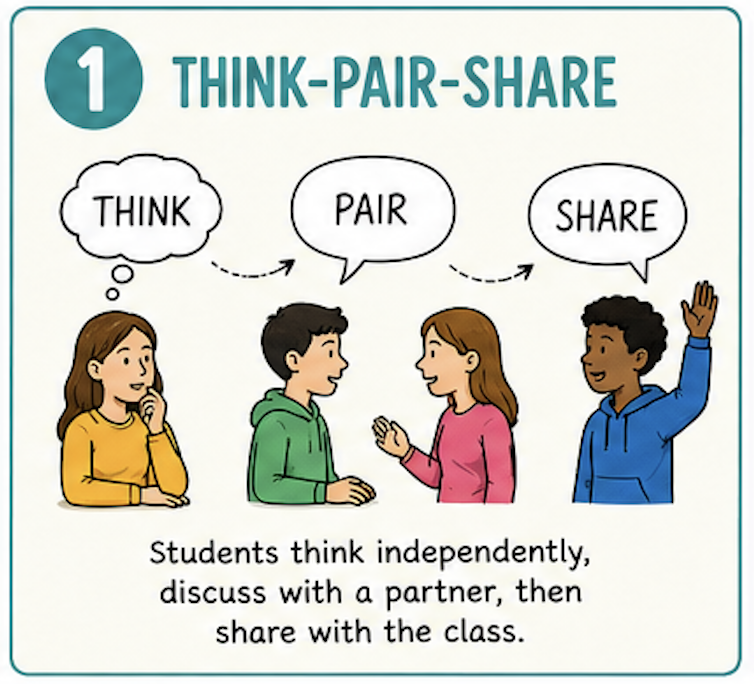
Instead of asking a question and hearing from the same three students every time, Think-Pair-Share gives every student an opportunity to process, rehearse, and discuss before sharing publicly.
The quality of responses improves dramatically when students have thinking time.
Why it works:
Lowers participation anxiety
Increases engagement
Supports multilingual learners
Improves quality of discussion
2. Whiteboard Responses
Want to know what every student is thinking?
Give them a whiteboard.
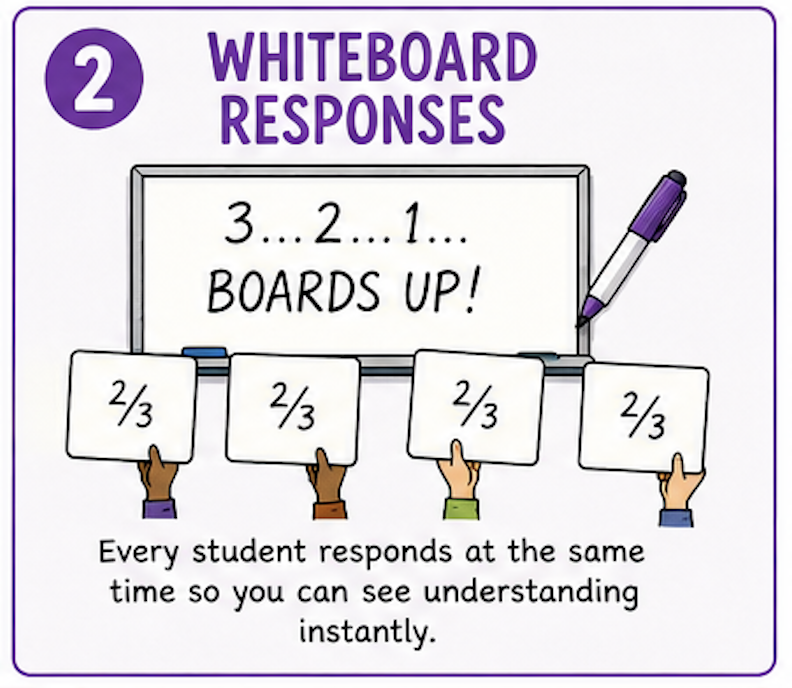
Whiteboards are one of the fastest ways to check for understanding because every student responds at the same time.
You immediately see misconceptions, confusion, and mastery.
My favorite management trick:
When students first get their whiteboards and markers, I have them draw their favorite food.
This accomplishes three things:
It identifies dried-out markers before instruction begins.
It gets the urge to doodle out of their system.
It allows me to quickly scan the room and make sure everyone has working materials.
Then we erase and get to work.
A simple routine that saves countless interruptions later.
3. Four Corners
Middle school students love to have opinions.
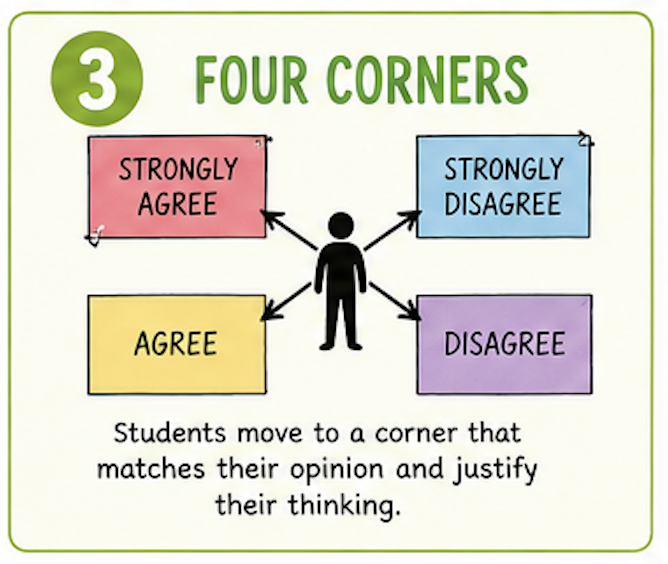
Four Corners gives them a chance to move, think, and defend those opinions.
Whether we're discussing a historical event, a scientific claim, or a character's decision, students physically move to a corner that represents their position and then justify their thinking.
The movement alone increases engagement.
The discussion is where the learning happens.
4. Carousel
Sometimes students need to get up and interact with ideas.
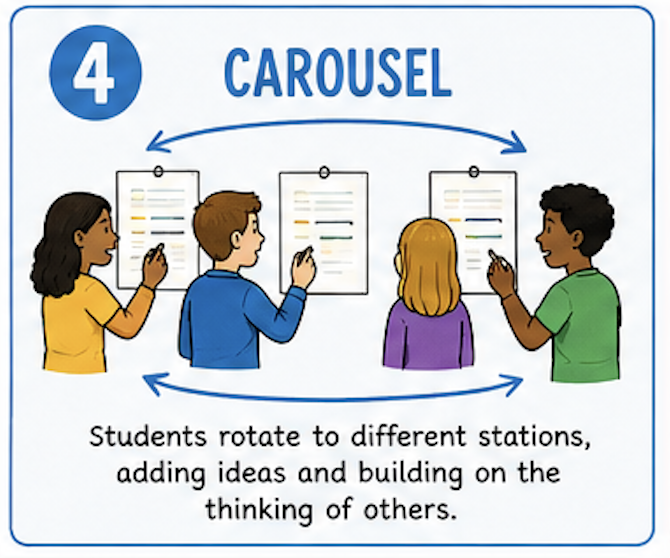
Carousel activities allow students to rotate through stations, responding to prompts, building on previous groups' thinking, and seeing multiple perspectives.
This strategy works especially well for:
Activating prior knowledge
Reviewing content
Brainstorming
Inquiry launches
Students leave with more ideas than they started with because they have interacted with the thinking of the entire class.
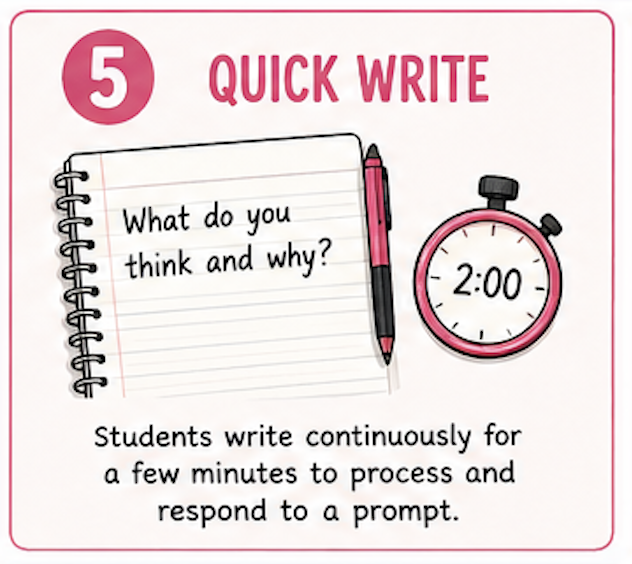
5. Quick Writes
One of the biggest mistakes teachers make is assuming students are ready to discuss immediately.
Most students need processing time.
Quick Writes provide that opportunity.
A two-minute response before discussion often produces richer conversations than any teacher-led questioning could.
When students write first, they have something to say.
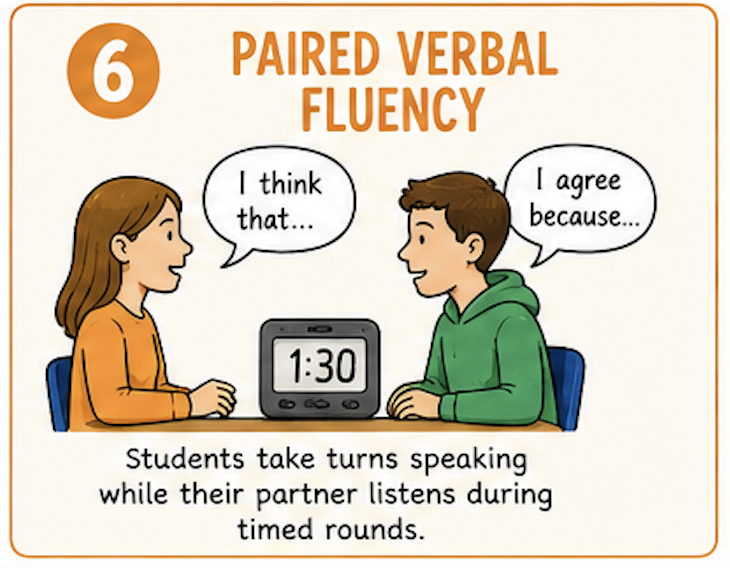
6. Paired Verbal Fluency
Students need opportunities to talk.
Not just the confident students.
All students.
Paired Verbal Fluency gives every learner structured speaking practice.
Using timed rounds ensures everyone participates and nobody dominates.
This strategy is especially powerful for multilingual learners and students who need additional processing time before whole-class discussions.
7. Save the Last Word for Me
This is one of my favorite discussion protocols because it teaches students how to analyze text collaboratively.
But here's the mistake many teachers make:
They jump straight into academic texts.
Instead, start with pop culture.
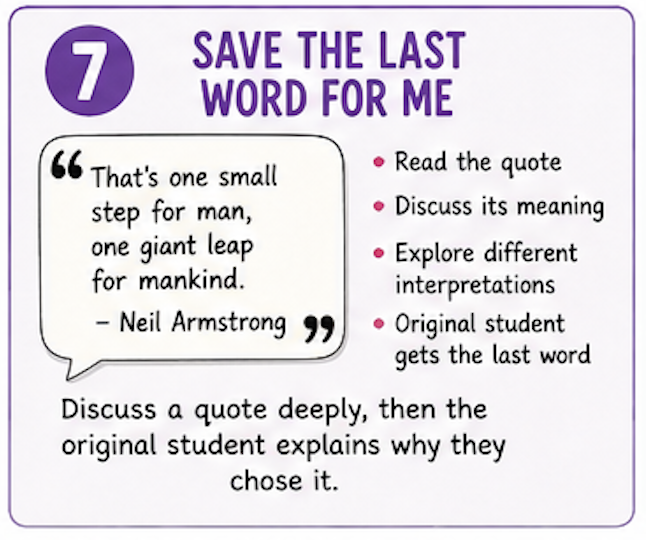
Use movie quotes.
Song lyrics.
Sports interviews.
Famous sayings.
Students already understand the content, which allows them to focus on learning the discussion protocol.
Once students understand how to discuss ideas, then move into literature, primary sources, and informational texts.
Another key:
Provide guiding questions.
Students don't automatically know how to analyze a quote.
Questions like:
What does this quote mean?
Why is it significant?
What might another person infer from it?
Could someone interpret it differently?
These prompts help students move beyond surface-level responses and into deeper thinking.
8. Grand Conversations
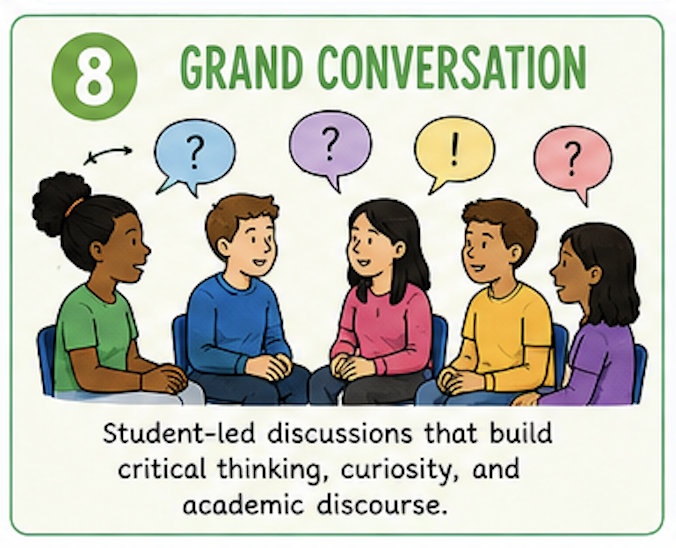
The best discussions don't always come from teacher-created questions.
Often, they come from student curiosity.
When preparing for a Grand Conversation, I like to ask students:
What surprised you?
What confused you?
What are you wondering?
What should we discuss as a class?
Students are more invested in discussions they helped create.
And perhaps most importantly:
Students can't discuss what they don't understand.
If a discussion falls flat, it may not be a motivation problem.
It may be a background knowledge problem.
Before expecting students to have deep conversations, we need to make sure they have enough knowledge, vocabulary, and experiences to contribute meaningfully.
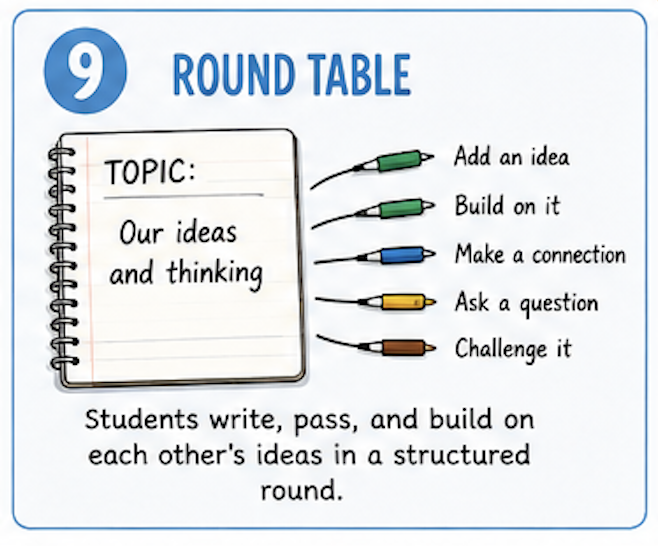
9. Round Table
Round Table is a simple collaborative writing strategy that ensures every student contributes.
Students write an idea, pass the paper, and build on the thinking of others.
The beauty of this strategy is that students don't need to come up with everything on their own.
They can respond, extend, challenge, or clarify ideas that are already on the page.
This creates a truly collaborative learning experience.
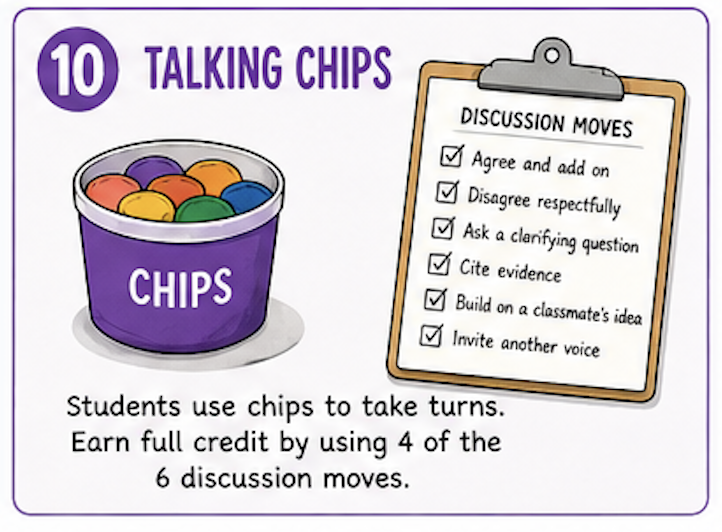
10. Talking Chips
If you've ever facilitated a discussion where a few students dominated while others stayed silent, Talking Chips is your solution.
Each student receives a set number of chips.
Every contribution costs one chip.
When the chips are gone, students listen.
This creates natural balance and encourages participation from everyone.
My favorite addition:
Use a discussion moves checklist.
Students earn full participation credit when they successfully demonstrate four of six discussion moves such as:
Agree and add on
Disagree respectfully
Ask a clarifying question
Cite evidence
Build on a classmate's idea
Invite another voice into the discussion
Notice what's being rewarded:
Not airtime.
Quality participation.
Once students earn their points, their job shifts from talking to helping others join the conversation.
That's where real discussion skills develop.
Final Thoughts
The goal isn't to collect dozens of strategies.
The goal is to create a classroom where students consistently think, talk, write, and engage with one another.
These ten strategies do exactly that.
Used consistently, they create classrooms where every student participates, every student has a voice, and learning becomes something students actively do rather than something that simply happens to them.
And honestly?
I'd rather see a teacher master these ten strategies than attempt fifty and implement none of them well.