Differentiating Socratic Seminars: It’s All in the Prep
(Read / Think / Talk)
If you’ve ever tried a Socratic Seminar and watched it unravel—silence, one student dominating, “I agree” on repeat, weak evidence, or an outer circle that drifts into side conversations—you’re not alone.
Here’s the shift that changed everything for me: most “discussion problems” are actually prep problems. When students don’t understand the content or don’t have thinking ready, the conversation defaults to the same few voices.
That was true in my classroom, too. Before I intentionally differentiated the prep, it was the same kids talking, while many of my MLL, neurodiverse, and shy students rarely participated—and the outside circle often tuned out. Once I implemented differentiated prep so everyone could enter with understanding and evidence, and gave the outer circle real accountability (coaching + tallying with support), my discussions ran smoother and participation expanded across the room.
Differentiation starts before the seminar.
The Read / Think / Talk Framework
1) READ: Content access so every student can enter the conversation
Students can’t debate what they can’t access. Differentiating the reading doesn’t lower expectations—it creates entry points so all students can engage with the same essential question.
What this looks like (and why it works):
Leveled texts on the same topic so struggling readers can still discuss the same big ideas.
A consistent annotation routine (symbols + margin notes + vocabulary focus) so reading becomes discussion prep, not “just read it.”
Electoral College Mini-Unit Example:
This unit includes 4 informational articles with a structured annotation guide and comprehension questions/answer keys to build understanding and prepare students for discussion.
It also includes ★ 6th-grade and ✦ 8th-grade versions of the articles to support diverse learning needs.
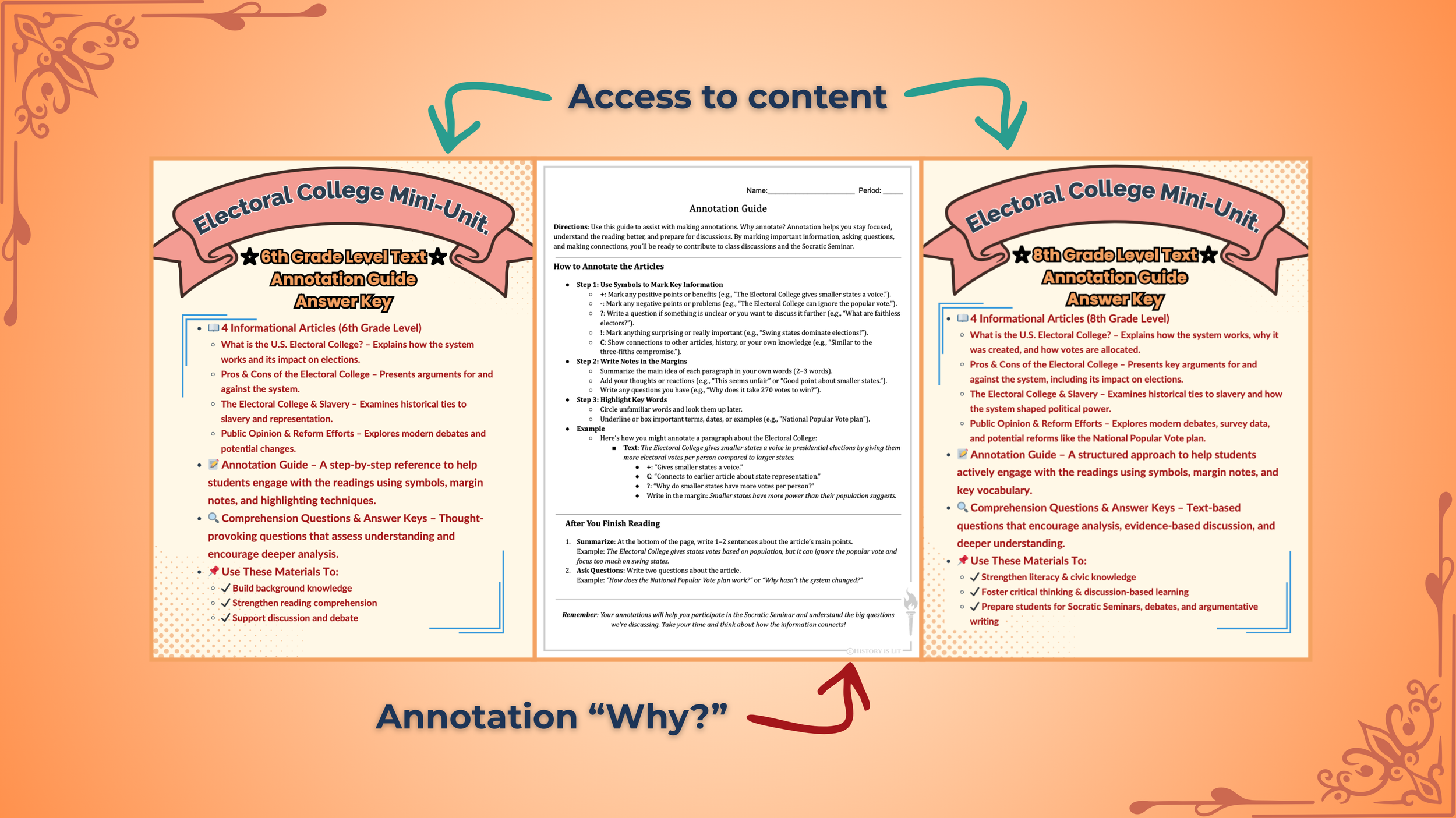
Universal Access
Making sure the content access is there to practice historical thinking skills.
2) THINK: Prep structures so students arrive with claims + evidence
Even when students understood the reading, seminars flop when students walk in with opinions but no organized evidence—or no rehearsal time to develop ideas.
What this looks like (and why it works):
A quick tool to activate background knowledge and track learning (so students aren’t starting at zero).
A structured process to collect and refine evidence before the “live” discussion.
Low-stakes collaboration that helps hesitant students build confidence without being put on the spot.
Electoral College Mini-Unit Example:
A KWL chart (with a “possible answers” scaffold) to support inquiry, discussion prep, and evidence-based learning.
A Give One, Get One routine that explicitly helps students exchange evidence and perspectives in a structured way (including directions, timing, and participation supports).
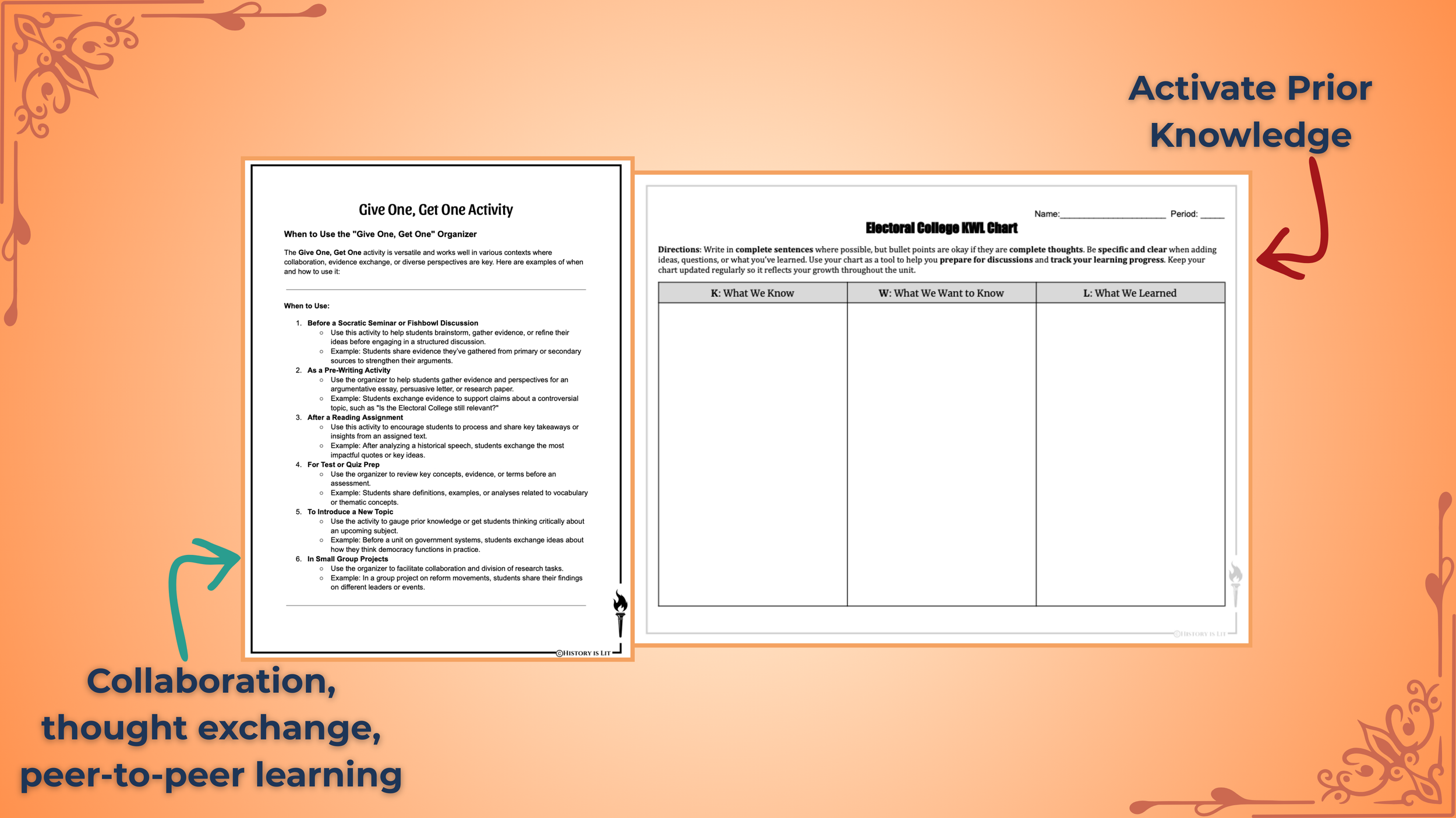
Prep!
Activate prior knowledge + swapping ideas!
3) TALK: Participation pathways so discussion isn’t only for the “talkers”
Even with great prep, students need structure in the moment—especially hesitant speakers and students who need language supports. Differentiation during TALK means clear roles, predictable routines, and supports that keep the conversation moving without the teacher taking over.
What this looks like (and why it works):
Fishbowl roles that keep both circles engaged and accountable.
Outer circle coaching that is specific (not vague “good job” feedback).
A clear expectation for equitable participation.
Electoral College Mini-Unit Example:
The unit explicitly prepares students for a Fishbowl Socratic Seminar with scaffolded supports like sentence frames and coaching sheets to increase participation and engagement.
And the outer circle is trained to tally discourse moves, provide actionable feedback, and monitor engagement, including a 1-minute coaching check-in.
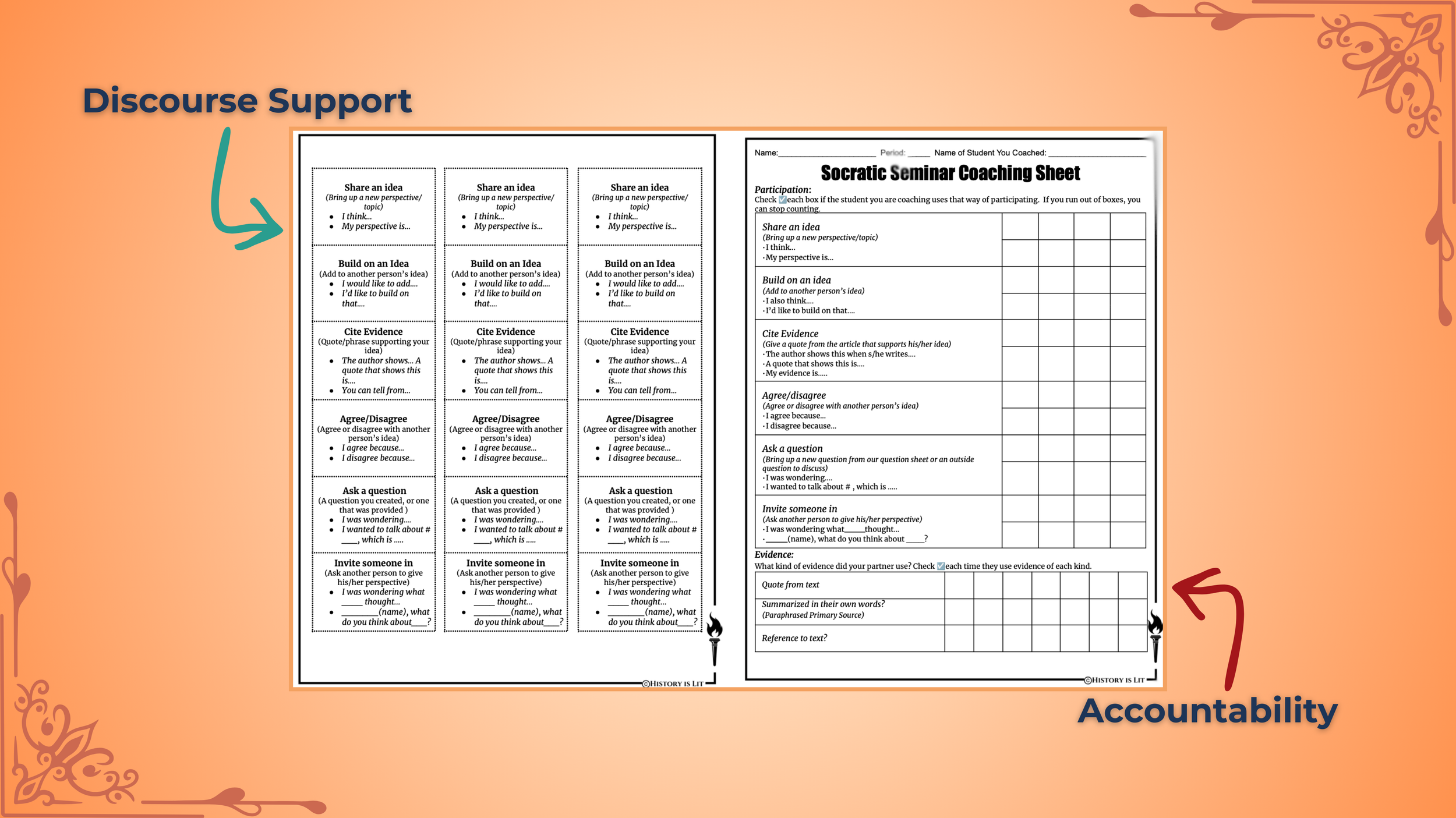
Discourse + Accountability
And the outer circle is trained to tally discourse moves, provide actionable feedback, and monitor engagement, including a 1-minute coaching check-in.
Quick fixes for the most common middle school seminar problems
“No one talks.”
This is usually a READ/THINK gap.fd
Fix: leveled access + annotation routine + evidence exchange (Give One, Get One).
“One student dominates.”
This is a TALK structure gap.
Fix: a simple equity norm such as “new voices first” + outer circle coaching prompts that invite quieter students in (not just track them).
“Everyone just agrees.”
This is a THINK gap.
Fix: require evidence and require a move (“add on,” “counterpoint,” “clarify,” “question”) so students must do more than echo.
“Outer circle zones out.”
This is an accountability gap.
Fix: outer circle needs a clear job (tally + feedback + check-in), plus tools in hand.
A real-world finish that makes the learning stick
One of the best ways to raise engagement is giving students a reason the conversation matters. After the seminar, the Electoral College Mini-Unit culminates in civic engagement through letter writing, where students use evidence from texts and discussion to write formal letters to elected representatives.
Want the differentiated seminar done for you?
If you want a full Socratic Seminar sequence where differentiation is already built in—leveled readings (★/✦), annotation + comprehension supports, structured evidence-building, and the Fishbowl system—start with the Electoral College Mini-Unit. It was designed for flexibility and differentiation, prepares students for Fishbowl discussion, and ends with a civic engagement letter-writing task.
Already have content you love, but want the Fishbowl system to use all year?
Use the Socratic Seminar Fishbowl materials/bundle as your reusable structure—room setup, roles, coaching sheets, rubrics, feedback tickets, and check-in supports—so the outside circle stays engaged and your discussions don’t default to the same few voices.